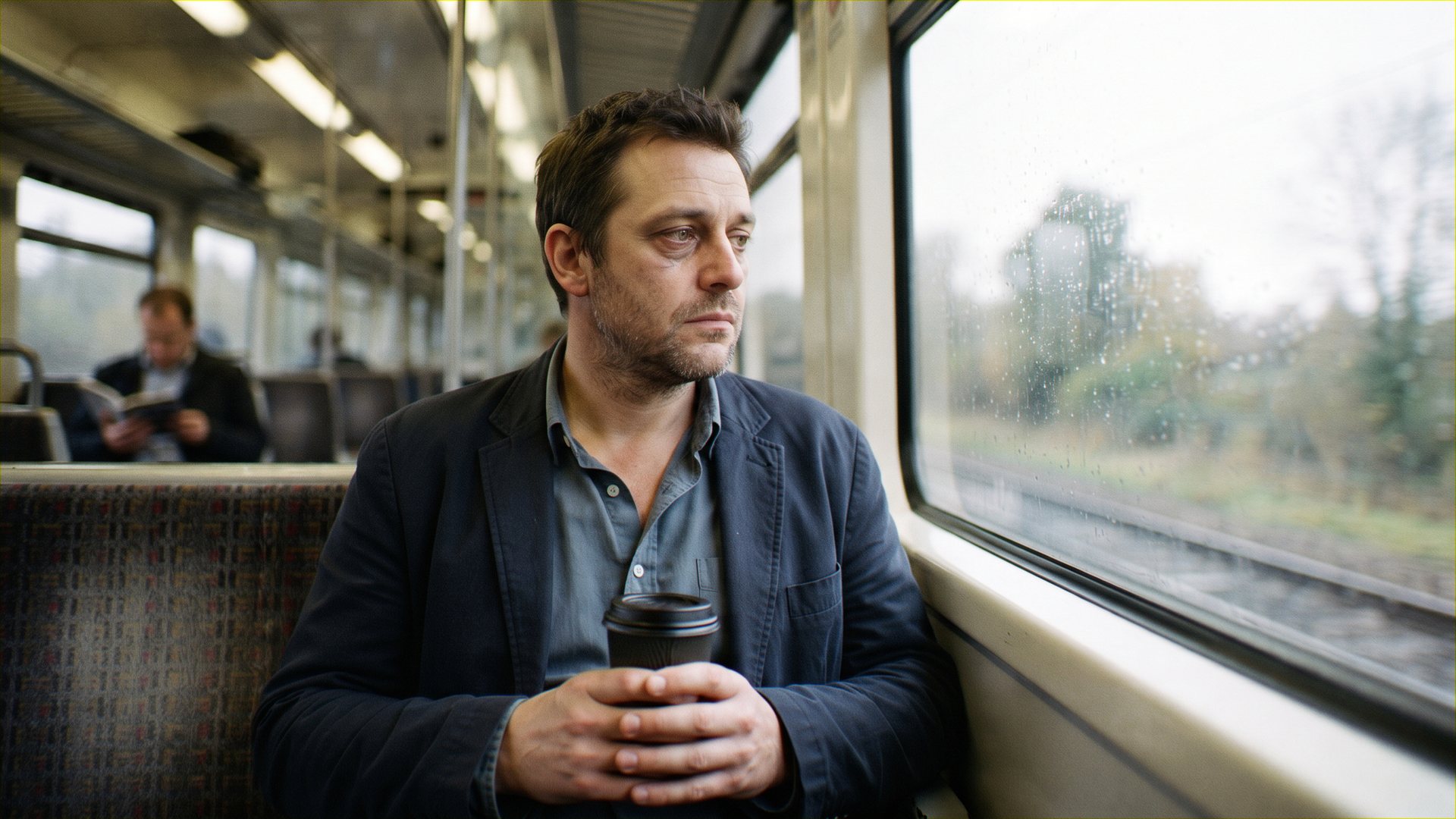
Why you wake at 3am.
The hour is not random. Cortisol bottoms out around midnight and starts climbing again through the second half of the night, and 3am sits in the middle of that handover.
Waking at 3am is usually a timing problem in the overnight cortisol curve rather than a sleep habit. Cortisol falls to its lowest point in the hours around midnight and then begins rising again through the second half of the night, ready for morning.2 When that rise starts early, or when secretory pulses that should stay quiet overnight begin firing, sleep in the second half of the night gets shallow enough that an arousal which would normally pass unnoticed becomes a full awakening.3
Cortisol is not the only thing that wakes people in that window. A falling blood glucose, alcohol clearing from the system, a vasomotor flush and obstructive breathing events all peak in the second half of the night, and each leaves a different signature. Which one is driving it is a measurement question, and the measurement that answers it is a multi-point cortisol curve read alongside overnight metabolic markers, not a single morning blood draw.
About one in three adults wakes at night at least three nights a week, and 23% wake at least once every night.1
Cortisol is released in pulses roughly every 60 to 120 minutes. The relative quiet of those pulses overnight is part of what keeps sleep consolidated.2,3
In chronic insomnia, 24-hour ACTH and cortisol output is higher than in normal sleepers, with the largest rises in the evening and the first half of the night.4
Evening cortisol correlates with the number of nocturnal awakenings, in normal sleepers as well as poor ones.5
Waking triggers a brief cortisol pulse of its own, so a sample taken during a 3am wake cannot establish cause.6
One night of curtailed sleep raised the following evening’s cortisol by 37 to 45% and delayed its shutdown by at least an hour.7
Your cortisol is already on its way up.
Cortisol does not sit flat overnight and switch on at the alarm. Output falls to its lowest point in the hours around midnight, holds there briefly, then climbs through the second half of the night so that concentrations are already high by the time you wake.2 By 3am the axis is usually in the early part of that climb, which is the first reason the hour is so consistent across people who have never spoken to each other about it.
Underneath the daily shape sits a faster one. Cortisol is released in discrete pulses roughly every 60 to 120 minutes, generated below the hypothalamus, and the amplitude of those pulses varies across the 24 hours.2 Through the night the pulses are small and infrequent, and that relative quiet appears to be part of what allows sleep to stay consolidated. When pulses arrive at night that should not be there, sleep becomes easier to break and awakenings run longer.3
This is the part worth holding onto. The problem is rarely that cortisol is high. It is that the shape is wrong for the hour. A number sitting inside its reference range at 8am tells you almost nothing about what the same axis was doing at 3am, which is why a normal morning cortisol and a broken night sit together so often on the same person.
What the curve looks like in people who wake most nights.
When researchers sampled plasma ACTH and cortisol serially across 24 hours in young people with chronic insomnia and in matched controls, total output was higher in the insomnia group and the number of secretory pulses per 24 hours was higher too. The circadian shape itself was preserved. The elevation was concentrated in the evening and the first half of the night, and the people with the most disturbed sleep secreted the most cortisol.4
The authors read that as a state of central nervous system arousal rather than a consequence of lost sleep, and the distinction has practical weight. If the driver were sleep loss, cortisol would be flat or low. It was neither. The axis was running warm before the person got into bed.
A second study looked at where the correlation actually sits. In men with severe chronic primary insomnia, both evening and overnight cortisol were raised, and evening cortisol tracked the number of nocturnal awakenings. That same relationship held in the healthy controls.5 The evening reading predicted the night, in people with a diagnosis and in people without one.
A 3am wake is usually the visible end of something that started in the evening. The curve is where that shows, and the evening is where it responds.
Cortisol at 3am is a consequence as well as a cause.
This is where the popular version of the story goes wrong. Wake at 3am, spit in a tube, find cortisol elevated, conclude that cortisol woke you. The physiology does not support that conclusion on its own. Spontaneous awakening is itself followed by a brief rise in ACTH and cortisol, measured in healthy men whose sleep had been left completely undisturbed.6 The act of waking moves the number you are trying to interpret.
That is the practical case for collecting a curve at fixed times across an ordinary day and night, instead of sampling in the moment something goes wrong. What you want to see is the shape the axis holds when nothing is being asked of it.
There is also a loop running underneath all of this. After a night of partial or total sleep restriction, cortisol the following evening ran 37 and 45 per cent higher than baseline, and the usual evening shutdown was delayed by at least an hour.7 Set that beside the finding that evening cortisol tracks the number of awakenings,5 and one broken night has a plausible mechanism for biasing the next one. Run that for a few weeks and an occasional 3am wake becomes the thing that happens every night.
What else wakes people at the same hour.
The second half of the night is crowded. Several mechanisms peak in the same window, and each leaves a different signature, which is what makes a careful description of the wake clinically useful before any test is ordered.
| Driver | Typical signature | Where to look |
|---|---|---|
| Cortisol timing | Wide awake, mind switched on | Multi-point cortisol curve, including the waking response |
| Falling glucose | Hot, hungry, heart going | Overnight and fasting glucose, fasting insulin, HbA1c |
| Alcohol | Asleep fast, awake 3–4 h later | Dose and timing relative to lights out |
| Vasomotor flush | Heat, then sweat, then awake | Cycle status, estradiol, FSH |
| Breathing events | Gasp, dry mouth, unrefreshed | Sleep study |
| Bladder | Up to the toilet, back to sleep quickly | Evening fluid timing, glucose, pelvic review |
Which system is actually doing it.
Start with glucose. In healthy volunteers, a controlled fall in blood glucose during sleep woke almost everyone it was applied to, about as readily in early sleep as in late sleep. What changed was the hormonal answer. The rises in adrenaline, noradrenaline, ACTH, cortisol and growth hormone were distinctly weaker in the second half of the night than in the first.8 The counter-regulatory response is quieter late, which is one reason the late-night version of this tends to present as a proper awakening rather than a stir.
Alcohol is the one people discount. Across every dose studied, it shortens the time it takes to fall asleep, consolidates the first half of the night, and increases disruption in the second half.9 Someone who falls asleep quickly after two glasses and wakes at 3am is describing that curve rather than an unusual one.
The vasomotor version has a physiology of its own. In women in the menopausal transition and after it, roughly half of nocturnal hot flushes came with an arousal or awakening, and those were accompanied by a heart-rate rise of about 20 per cent and systolic and diastolic pressure rises of around 6 and 5 mmHg, sustained for several minutes.10 The heat is the trigger. The cardiovascular surge is why the person is properly awake afterwards rather than drifting back down.
Breathing is the one to rule out first when the description fits. Obstructive events cluster in REM sleep, and REM is weighted towards the second half of the night. In just over a thousand consecutive adults referred for a sleep study, REM-related sleep-disordered breathing accounted for 13.5 to 36.7 per cent of cases depending on the definition used, and was more common in women and in younger people.11 Waking with a gasp, a dry mouth, or unrefreshed after eight hours is worth a sleep study before it is worth a cortisol test.
Different system.
Different answer →
The useful question is which system, not which hour.
What a full curve shows.
A single morning blood cortisol gives you one point on a curve that has at least four clinically interesting parts: the waking response, the daytime slope, the evening level and the overnight floor. The collection that answers a 3am question is a multi-point sample across an ordinary day, timed relative to waking rather than to the clock, with the first samples inside the 30 to 45 minutes after waking so the awakening response is captured properly.12 Both saliva and dried urine do this well; the method comparison sits in the cortisol testing guide, and the practical version is in how to test cortisol at home.
Two things are worth running alongside it, because the table above is a differential and not a ranking. Fasting glucose with fasting insulin, plus overnight glucose where a continuous monitor is available, covers the metabolic driver. A sleep study covers the breathing one, and should come first whenever the description includes snoring, gasping, or waking unrefreshed after a full night.
What you are reading in the result is not one flagged value. It is whether the evening sits high, whether the waking response is blunted or exaggerated, and whether the daytime slope has gone flat. Those three read together point at which lever is worth pulling, and they give you a baseline to re-measure against in six months. That last part is where the value compounds, and it is the same logic that applies to deep sleep and recovery: one reading is a snapshot, and the trajectory is the finding.
If the bloods have already come back clean and the nights are still broken, that combination is common enough to have its own pattern, and it is covered in why you are exhausted with normal blood tests.
What the data actually says.
3am sits inside the window where the cortisol axis is climbing back up from its overnight low, which is why the hour is so consistent between people.
The clinical signal is the shape of the cortisol curve across 24 hours, not the height of any single value.
In chronic insomnia, cortisol output is raised across the whole 24 hours, with the largest rises in the evening and the first half of the night.
Evening cortisol correlates with how many times a person wakes overnight, in normal sleepers as well as in poor ones.
Waking triggers its own brief cortisol pulse, so a sample taken during a 3am wake cannot establish what caused it.
Glucose, alcohol, vasomotor flushes and obstructive breathing events all wake people in the same window, and each one has a different signature and a different test.
Frequently asked.
Why do I wake up at 3am every night?
Most often because the overnight cortisol curve is climbing earlier or harder than it should, which leaves sleep in the second half of the night shallow enough for a normal arousal to become a full awakening. Falling blood glucose, alcohol, vasomotor flushes and obstructive breathing events all peak in the same window and produce the same hour with different signatures.
Does high cortisol wake you up at 3am?
It can contribute, but a cortisol sample taken during the wake cannot prove it, because waking triggers a brief cortisol rise on its own. The useful measurement is a multi-point curve collected across an ordinary day and night, where the evening level, the waking response and the daytime slope can be read together.
Should I eat something when I wake at 3am?
If the wake arrives with heat, hunger and a racing heart, eating often settles it, and that response is itself information: it points at the metabolic side rather than the cortisol side. Fasting insulin and overnight glucose are worth measuring before a 3am snack becomes a permanent arrangement.
What test shows the overnight cortisol curve?
A multi-point salivary or dried urine collection taken at fixed intervals from waking, including samples in the first 30 to 45 minutes after waking for the awakening response, plus an evening and a late-night sample. A single morning blood cortisol gives one point and cannot show shape.
How long does it take to change the pattern?
Changes to sleep timing and evening load usually show up in how the night feels within two to four weeks. A measurable change in the shape of the cortisol curve moves more slowly, and is worth re-testing at around six months rather than six weeks.
Your overnight pattern, measured.
A structured protocol that measures the cortisol curve, overnight metabolic markers and sleep together, then rebuilds capacity from what the data shows.
Book a discovery callReferences.
- Ohayon MM. Nocturnal awakenings and comorbid disorders in the American general population. Journal of Psychiatric Research. 2008;43(1):48–54. doi.org/10.1016/j.jpsychires.2008.02.001
- Lightman SL, Birnie MT, Conway-Campbell BL. Dynamics of ACTH and cortisol secretion and implications for disease. Endocrine Reviews. 2020;41(3):bnaa002. doi.org/10.1210/endrev/bnaa002
- Vargas I, Vgontzas AN, Abelson JL, Faghih RT, Morales KH, Perlis ML. Altered ultradian cortisol rhythmicity as a potential neurobiologic substrate for chronic insomnia. Sleep Medicine Reviews. 2018;41:234–243. doi.org/10.1016/j.smrv.2018.03.003
- Vgontzas AN, Bixler EO, Lin HM, et al. Chronic insomnia is associated with nyctohemeral activation of the hypothalamic-pituitary-adrenal axis: clinical implications. The Journal of Clinical Endocrinology & Metabolism. 2001;86(8):3787–3794. doi.org/10.1210/jcem.86.8.7778
- Rodenbeck A, Huether G, Rüther E, Hajak G. Interactions between evening and nocturnal cortisol secretion and sleep parameters in patients with severe chronic primary insomnia. Neuroscience Letters. 2002;324(2):159–163. doi.org/10.1016/S0304-3940(02)00192-1
- Späth-Schwalbe E, Schöller T, Kern W, Fehm HL, Born J. Nocturnal adrenocorticotropin and cortisol secretion depends on sleep duration and decreases in association with spontaneous awakening in the morning. The Journal of Clinical Endocrinology & Metabolism. 1992;75(6):1431–1435. doi.org/10.1210/jcem.75.6.1334495
- Leproult R, Copinschi G, Buxton O, Van Cauter E. Sleep loss results in an elevation of cortisol levels the next evening. Sleep. 1997;20(10):865–870. pubmed.ncbi.nlm.nih.gov/9415946
- Jauch-Chara K, Hallschmid M, Gais S, et al. Awakening and counterregulatory response to hypoglycemia during early and late sleep. Diabetes. 2007;56(7):1938–1942. doi.org/10.2337/db07-0044
- Ebrahim IO, Shapiro CM, Williams AJ, Fenwick PB. Alcohol and sleep I: effects on normal sleep. Alcoholism: Clinical and Experimental Research. 2013;37(4):539–549. doi.org/10.1111/acer.12006
- Baker FC, Forouzanfar M, Goldstone A, et al. Changes in heart rate and blood pressure during nocturnal hot flashes associated with and without awakenings. Sleep. 2019;42(11):zsz175. doi.org/10.1093/sleep/zsz175
- Conwell W, Patel B, Doeing D, et al. Prevalence, clinical features, and CPAP adherence in REM-related sleep-disordered breathing: a cross-sectional analysis of a large clinical population. Sleep and Breathing. 2012;16(2):519–526. doi.org/10.1007/s11325-011-0537-6
- Stalder T, Lupien SJ, Kudielka BM, et al. Evaluation and update of the expert consensus guidelines for the assessment of the cortisol awakening response (CAR). Psychoneuroendocrinology. 2022;146:105946. doi.org/10.1016/j.psyneuen.2022.105946